Services
Natural Environment
Information about the natural environment
Set in the beautiful open countryside of north-west Gloucestershire, overlooking the Malvern Hills, Pauntley has some of the county’s most amazing scenery. From this page you will be able to find some information about some sites of natural interest in the area from the left hand side menu.
Compton Green
In January 2009 Pauntley Parish Council was successful in its application to the O² ‘It’s Your Community’ fund for a grant of £940 towards the conservation work needed on the small area of common land at Compton Green. This was something that was identified in our Parish Plan in 2007 as a project that many residents supported, with the majority wanting to see left essentially unchanged but with some management for wildlife.
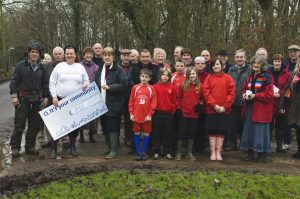
Brenda Bainbridge, then Chair of Pauntley Parish Council, receiving the cheque for £940 from Angela Johnson of O².
This award paid for essential tree surgery to remove unsafe trees, which took place on 28 January 2009, when a representative from O² came along to present the award to us. We also worked with a group of children from Pauntley Primary School, as part of their final year project. They helped us put up bird and bat boxes at the site, provided by Gloucestershire Wildlife Trust. We will monitor the bird boxes although, as a protected species, the bats cannot be disturbed or handled except by a licensed person.
Mr and Mrs James, from Compton Green, have been watching the wildlife at the site for many years and gave the children records of their sightings. We are continuing to collect further records to send to Gloucestershire Environmental Records Centre, and we have already seen the spread of some plants, such as wild daffodils, where the removal of the trees has opened up the wood, and butterflies have appeared in the clearings too. Clearance of some of the scrub has also taken place and this will be ongoing.
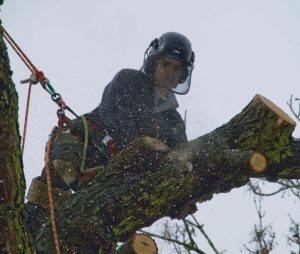
Rosie Woolley from Gloucestershire Wildlife Trust, came to run a pond-dipping afternoon with the children, to look for some amphibians and insects to add to the records. We will be setting up a light-trap for moths in the summer months, when we hope to have the help of the schoolchildren, and returning the next morning to record any moths we have found and releasing them back onto the site. If the weather is good we will also be using a bat detector, which will tell us if there are any bats on the site by picking up their echo-location signals and enabling the species to be identified. A native hedge around the perimeter of the site, which it is hoped to plant in the future, will help attract more birds and bats to the site by providing shelter for them and also food (such as berries and seeds), and will also encourage the insects on which some of them feed. We will continue to collect records of wildlife at the site and would be glad of any records of birds, animals, butterflies, plants etc, together with the date. This will help us see if our work is helping wildlife at the site and whether any particular species are benefiting and can be further encouraged.
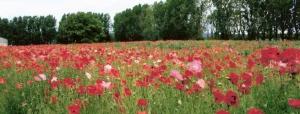
Compton Green Wildflower Meadow
Compton Green Wildflower Meadow has been created at Compton Green Business Park by Mr and Mrs Stallard and is open to the public for walks through the meadow. There is a good display of cowslips, which will be followed by summer flowers, particularly poppies. Parking is at the Business Park, and there are signs to the meadow. Entrance is free but donations for Pauntley Church are welcomed.
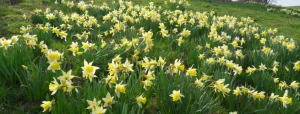
Ketford Daffodil Bank
The Newent area is famous for its wild daffodils, once common but now sadly mainly found only in areas managed by wildlife organisation. The daffodils were once so numerous that they were picked in large numbers. The wild daffodils still grow here in the spring, although they are now protected and no longer picked in great numbers and sent to market, as they once were. As much of the land in Pauntley has remained pasture for many years, wild daffodils thrive in a number of areas, and many local farmers and landowners also manage the land for their benefit with careful timing of grazing by sheep and cattle.
Gloucestershire Wildlife Trust (GWT) now owns and manages Ketford Bank, an important site for wild daffodils. A floral survey was carried out on Ketford Daffodil Bank in the early 1990s and showed a rich variety of flora, containing some rare species. Following several years of neglect at the site, it was taken into ownership by GWT in 2010 and they now manage it with the help of their flock of Hebridean sheep, which are put in to graze the reserve out of daffodil season to keep the vegetation down.
The site is located in the Leadon valley at Ketford and can be reached along the bridleway from Ketford to Dymock, where GWT has an information board just inside the gate to the reserve, which is open at all times unless stock are grazing there. This is one of the Poet’s Paths, named after the Dymock Poets who lived in the area just before the First World War and who were attracted to it by its remoteness and its picturesque scenery. Edward Thomas, Robert Frost, John Drinkwater, Wilfred Wilson Gibson and Lascelles Abercombie all lived in neighbouring parishes for a time and brought with them other famous visitors, such as Rupert Brooke, Eleanor Farjeon and Ivor Gurney. The natural beauty of the area inspired many of their poems, particularly those of Gibson. More information on the Dymock Poets can be found on the website of the Friends of the Dymock Poets on http://www.dymockpoets.co.uk.
Other areas where you can see good displays of wild daffodils are Wormes Meadow in Pool Hill, running along the side of the lane from the Old Chapel to Harridge Coppice, and on the wooded banks of Great Harridge, close to the River Leadon near Durbridge. They are several other fields running alongside the Leadon in the parish where the damp ground is ideal for their needs.
For more information on Gloucestershire Wildlife Trust